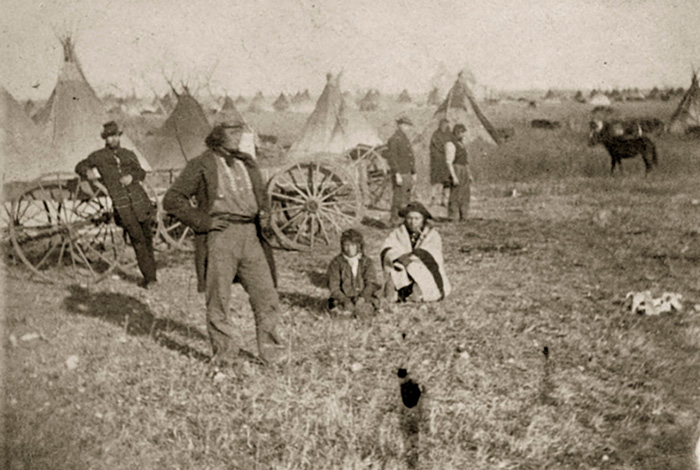
On this day in 1862, the largest mass execution in U.S. history took place when 38 Dakota men were executed in Minnesota by the state as part of the Dakota War. The following year, the rest of the Dakota were expelled from the state.
The Dakota War of 1862, also known as the Sioux Uprising, was an armed conflict between the United States and several bands of Dakota (also known as the eastern Sioux). The war began on August 17th, 1862 in southwest Minnesota after four Dakota were killed by white settlers, leading tribe members to initiate a series of violent attacks on settlers throughout the Minnesota River Valley in an attempt to drive them out of the area.
Over the next several months, battles of the Dakota against settlers and later, the United States Army, ended with the surrender of most of the Dakota bands. By late December 1862, U.S. soldiers had taken captive more than a thousand Dakota, including women, children and elderly men in addition to warriors. A military tribunal tried the men, sentencing 303 to death.
President Lincoln commuted the sentence of 264 of them, and the remaining 38 were executed on December 26th in Mankato, Minnesota. The following year, the rest of the Dakota were expelled from Minnesota to Nebraska and South Dakota, and U.S. Congress abolished their reservations.
"You have deceived me. You told me that if we followed the advice of General Sibley, and gave ourselves up to the whites, all would be well; no innocent man would be injured. I have not killed, wounded or injured a white man, or any white persons. I have not participated in the plunder of their property; and yet to-day I am set apart for execution, and must die in a few days, while men who are guilty will remain in prison. My wife is your daughter, my children are your grandchildren. I leave them all in your care and under your protection. Do not let them suffer; and when my children are grown up, let them know that their father died because he followed the advice of his chief, and without having the blood of a white man to answer for to the Great Spirit."
- Letter from Hdainyanka to Chief Wabasha written shortly before his execution