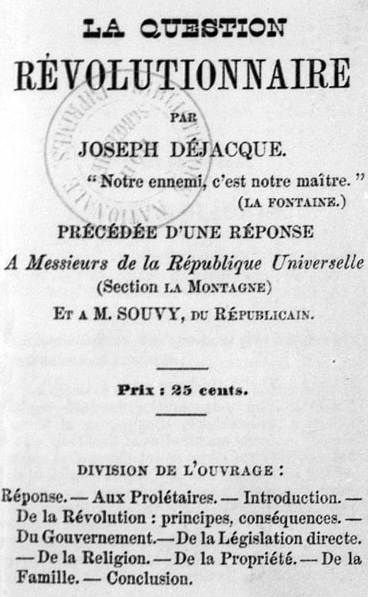
Joseph Déjacque, born on this day in 1821, was a French anarcho-communist poet and philosopher who coined the term "libertarian" in reference to his own anti-capitalist politics. He utilized the term in an 1857 letter written to Pierre-Joseph Proudhon, criticizing his sexist views and support of individual ownership of the product of labor and a market economy.
Déjacque was sentenced to two years of prison for his collection of poems "Les Lazaréennes, Fables et Poésies Sociales", but escaped to London around the time of the December 2nd, 1851 coup d'état. There, he joined a small community of outlaws gathered in Jersey and published "La question révolutionnaire", an exposition of the philosophy of anarchism.
Later, Déjacque moved to the United States, where he publicly condemned the hanging of John Brown and promoted the abolitionist cause. As the American Civil War began, Déjacque published the last issue of his paper "Libertaire" with an urgent appeal in which he urges the American people, whom he would like to be "less religious and more socialist", to defend freedom and the Republic against the "Jesuits, slavers, absolutists and authoritarians" who were at their door.
Déjacque then returned to France, living his remaining years in poverty and passing away in 1864.
"Choose then: —Property is the negation of liberty. —Liberty is the negation of property. —Social slavery and individual property, this is what authority affirms. —Individual liberty and social property, that is the affirmation of anarchy.
People of progress, martyred by authority, choose anarchy!"
- Joseph Déjacque